
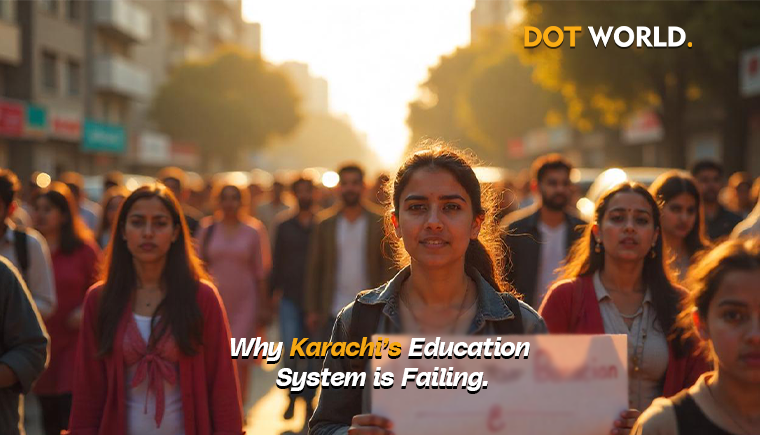
Why Karachi’s Education System Is Failing: A Crisis That Needs Urgent Attention
Karachi, Pakistan’s economic hub and largest city, is home to over 20 million people. It boasts skyscrapers, tech startups, and a vibrant culture — yet its education system is hanging by a thread. For a city of such national significance, the collapse of primary education and the lack of access to quality education in Pakistan is not only ironic, but deeply alarming.
In a city where ambition thrives and opportunities abound, one would expect a strong, structured, and equitable education system. However, Karachi tells a different story — one riddled with underfunded schools, overwhelmed teachers, and a government that seems more focused on managing crises than creating a sustainable future for its children.
This blog explores why Karachi’s education system is in such a dismal state, and what can be done to fix it — before it’s too late.
A City of Dreams, But Not for Students
Karachi is often called “the city that never sleeps,” and for good reason. It is Pakistan’s commercial capital, responsible for a large chunk of the national GDP. But when it comes to education, the city falls flat. According to various reports, a shocking percentage of children in Karachi either never go to school or drop out before completing primary education.
In our Real Story of Karachi, we dive deep into how urban neglect, poor infrastructure, and political incompetence have led to the slow decay of essential public services — especially education. Karachi may be rich in spirit and hustle, but its education system is bankrupt in vision and support.
Primary Education: Cracked at the Foundation
Every thriving education system starts with strong primary education. If a child doesn’t gain basic literacy, numeracy, and critical thinking skills at the primary level, their academic journey is almost guaranteed to collapse.
In Karachi, however, primary education is a forgotten priority. Government schools are either severely overcrowded or in disrepair. Many operate without proper electricity, sanitation, or trained teachers. Others are simply ghost schools — registered on paper, but non-functional in reality.
And while private schools do exist, their skyrocketing fees make them inaccessible for the majority of Karachi’s population, especially in lower-income districts like Orangi Town, Lyari, or Korangi.
This systemic failure of primary education means children in Karachi often start life with a major disadvantage — one that follows them for the rest of their lives.
Inequality and Educational Access in Karachi
Another massive challenge is inequality. Karachi is a deeply divided city — socially, economically, and linguistically. These divisions are reflected in its education landscape.
Children from elite neighborhoods like Clifton and DHA attend international schools with access to digital tools, global curricula, and extracurricular activities. Meanwhile, children in working-class neighborhoods often walk miles to attend poorly resourced schools that lack even basic supplies.
Such disparity makes it nearly impossible to ensure quality education in Pakistan, especially when the education a child receives depends entirely on the ZIP code they’re born into.
In our video on the Reality of Pakistan’s Education System, we showcase how these inequalities aren’t accidental — they’re the result of decades of neglect, corruption, and a lack of political will.
The Curse of Politics in Education
In Karachi, education and politics are inseparable — and not in a good way. Education boards, teacher appointments, and school management are all politicized. Instead of focusing on educational outcomes, many institutions prioritize loyalty, influence, and financial gain.
Political interference often results in:
- Unqualified teacher hires
- Misallocation of resources
- Biased curriculums
- Appointment of school heads based on party affiliations
Until this grip of politics is broken, there is little hope for structural reform in Karachi’s education system.
Teacher Training and Accountability
No education system can rise above the quality of its teachers. Yet in Karachi, teacher training remains outdated, underfunded, and mismanaged. Most teachers in public schools receive little to no training in modern pedagogy, emotional intelligence, or child-centered teaching practices.
Without proper support and supervision, many teachers in Karachi end up:
- Using outdated rote learning methods
- Failing to engage students
- Resorting to corporal punishment
- Skipping classes without consequences
This directly affects both primary education outcomes and the long-term goal of ensuring quality education in Pakistan.
The Role of NGOs and Civil Society
Despite the bleak landscape, all is not lost. Several non-governmental organizations (NGOs) and civil society groups have stepped in to fill the gaps left by the state.
Organizations working in Karachi’s education sector are:
- Rebuilding schools in underserved areas
- Providing free or subsidized education
- Training teachers
- Promoting child rights and literacy
At MyDotWorld, we frequently collaborate with such organizations and spotlight their efforts through our blogs and videos, pushing for grassroots-level change.
Overcrowding, Urbanization, and Population Pressure
Karachi is one of the fastest-growing cities in the world. This rapid urban expansion has led to severe overcrowding in schools. In some cases, classrooms meant for 30 students are hosting 80–100 kids.
With no cap on class size, no individual attention, and limited teacher resources, students suffer. Many fall behind and eventually drop out, compounding the failure of primary education in the city.
Urban planning and education must go hand-in-hand — but Karachi’s planning authorities have long ignored the educational needs of its exploding population.
Digital Divide and the Future of Education
In the wake of COVID-19, digital learning became essential. But in Karachi, the digital divide is stark. Wealthier schools quickly shifted to online platforms, while lower-income students were left behind without access to devices, internet, or even electricity.
While online schools could potentially help bridge some of these gaps in the future, their success in Karachi hinges on massive infrastructure investments and policy reforms.
For insights on how digital learning could reshape education, check out our video on Electric Vehicles & Tech Shifts, where we discuss broader digital trends impacting Pakistan.
Can Karachi Be a Model for Quality Education in Pakistan?
The short answer: Yes — but it will take serious political commitment, investment, and collaboration.
Karachi, if managed correctly, could be the testing ground for reforms that could then scale to other parts of the country. Steps could include:
- Strengthening primary education
- Decentralizing the bureaucracy
- Increasing teacher salaries and accountability
- Modernizing curriculum
- Partnering with tech innovators and NGOs
- Ensuring equitable access to schools across districts
Karachi has the brains, the heart, and the hustle — but it needs a clear vision to turn chaos into opportunity.
Final Thoughts
Karachi’s failing education system isn’t just a local issue — it’s a national crisis. A city that powers the country’s economy cannot afford to leave its future generations behind.
If Pakistan truly wants to achieve quality education in Pakistan, the reform must start with primary education — and that reform must begin in Karachi.
At MyDotWorld, we believe in solutions rooted in reality. Through our videos, articles, and collaborations, we aim to raise awareness, spark conversations, and push for change that matters — starting with the classrooms of Karachi.
