
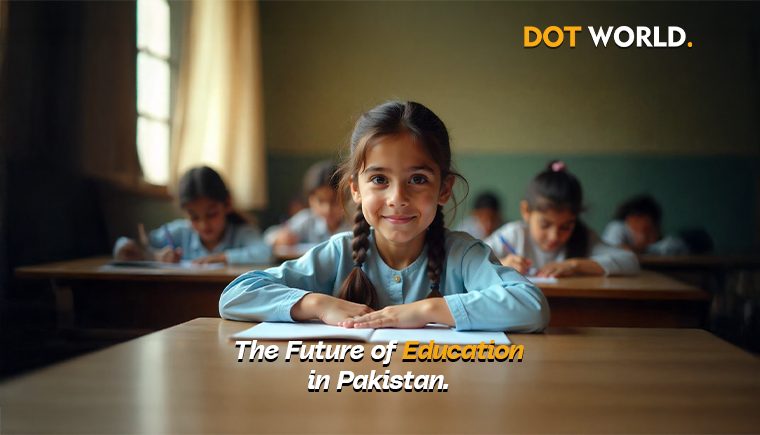
Education is not just the foundation of a nation — it’s the fuel that drives progress, reform, and innovation. In Pakistan, a country rich with talent yet challenged by systemic barriers, the question isn’t whether education is important. The real question is: what does the future hold for Pakistan’s education?
The journey of education in Pakistan has been long and uneven. From urban centers boasting elite institutions to rural areas struggling for basic facilities, the landscape is both diverse and divided. As we move further into the 21st century, reimagining the education system in Pakistan has never been more urgent.
A Broken System — Or a System Never Fully Built?
Let’s begin with the truth: the education system in Pakistan has been marred by inconsistency, inequality, and lack of vision. Whether it’s the shortage of trained teachers, poor infrastructure, outdated curriculum, or the linguistic divide between Urdu- and English-medium schools — the problems are deep-rooted.
Our current reality is highlighted in our video on the reality of Pakistan’s education system, where we examine how structural problems are suffocating the future of millions of children. It’s not just about schools lacking desks or electricity — it’s about a lost generation of potential thinkers, doers, and leaders.
Visit our full Video Gallery to see how we explore similar social issues across Pakistan.
Is Education in Pakistan a Trap?
There’s a growing debate about whether our current system actually empowers students — or traps them in an outdated framework. Our investigative video, “Is Education Really a Trap?” explores how Pakistan’s education often becomes a rat race rather than a journey of personal growth.
Students are pushed into memorization, pressured by family expectations, and robbed of creativity. This results in degrees that don’t lead to jobs, and a workforce that lacks innovation. If we want quality education in Pakistan, this mindset must change.
Vision 2030: What Should Education in Pakistan Look Like?
So what can we envision for the future?
1. Equal Access Across All Provinces
Rural Sindh, Balochistan, Gilgit-Baltistan, and parts of KP still face severe inequalities. The future of education in Pakistan must be inclusive. No child should be denied their right to learn because of geography.
2. Teacher Training & Support
Teachers are the backbone of the system. Without proper training and fair pay, we can’t expect quality education in Pakistan. We must invest in continuous professional development and modern teaching methods.
3. Curriculum Reform
The current curriculum is outdated and rigid. A future-ready education system in Pakistan should promote critical thinking, digital literacy, and social awareness.
4. Digital Education Integration
COVID-19 showed us that online education isn’t just a luxury — it’s a necessity. If implemented correctly, digital learning platforms can help democratize education in Pakistan, bringing quality content to even the most remote areas.
5. Vocational & Technical Training
Not every student wants — or needs — a university degree. Introducing strong vocational training programs can empower youth with skills that match industry demands.
Role of Government and Private Sector
Both sectors need to move beyond promises and focus on execution. Policies must be data-driven, transparent, and responsive to local needs. More importantly, public-private partnerships can bridge gaps in infrastructure and funding.
At MyDotWorld, we aim to amplify these solutions and create public awareness through our blogs and documentaries. Our brand collaboration page is open to organizations who want to invest in meaningful change.
Role of Parents and Society
No system can succeed without community involvement. Parents must stop seeing education as a status symbol, and instead support their children in discovering their strengths — whether it lies in coding, carpentry, or creative writing.
Communities should also hold schools accountable, demand better policies, and engage in dialogue with stakeholders. The future of Pakistan’s education is not just the government’s responsibility — it’s ours.
Education and National Development
Countries that invested in education — like Finland, South Korea, and Singapore — transformed their economies within a generation. Why can’t Pakistan do the same?
To understand how other systems impact national progress, our video on PIA’s rise and fall serves as a powerful analogy. It shows how a lack of vision can destroy even the most promising institutions. We must not let that happen to Pakistan’s education system.
Emerging Technologies and AI in Classrooms
The future of education in Pakistan must also embrace Artificial Intelligence and other cutting-edge technologies. AI can personalize learning, detect struggling students early, and optimize teacher workload.
Electric vehicles and digital automation are already reshaping our world. See our video on EVs to understand how fast technology is evolving — and how education needs to keep pace.
Hope from the Ground
Despite challenges, there are success stories — from NGOs building schools in tribal regions to students from humble backgrounds securing international scholarships. We must amplify these voices and learn from what’s working.
Our Real Story of Karachi gives a glimpse into how urban resilience can inspire reform — even in the face of neglect.
Final Thoughts
The future of education in Pakistan lies in innovation, inclusion, and intent. We cannot continue with business-as-usual while millions are denied their right to learn. Change won’t happen overnight, but it begins with awareness — and action.
Let’s build a future where quality education in Pakistan isn’t a privilege, but a promise.
